
To Our Determined Team of Defenders:
Welcome to our annual Session-ending report. As is our custom each year, we provide you with a final review by covering “The Good, The Bad, and The Ugly” from the recent 2026 Legislative Session in Olympia. This was another tough year for conservatives in Washington State. Despite a significant number of discouraging bills headed to the Governor’s desk, Christians across our fine state planted a vast number of “seeds” that, with prayer, will ultimately germinate and become a bountiful harvest.
That is not my promise, it is God’s. Galatians 6:9 (NIV) states:
“Let us not become weary in doing good,
for at the proper time we will reap a harvest if we do not give up.”
I did not witness our conservative legislators, their staff, our Defenders, our Capitol Prayer Tour teams, and other Christian organizations “giving up” this year. In fact, I believe we all fought to the point of weariness with dogged determination and a will to see righteousness prevail.
🙏🏻 🙏🏻 🙏🏻
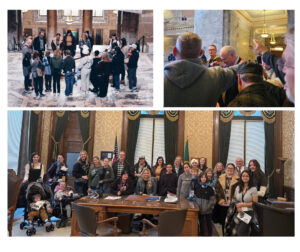
In that spirit of perseverance and spiritual battle, we want to give special thanks to those Defenders who joined us for the daily FPIW Prayer Tour at the Capitol. This year the Prayer Tour saw an increase from 254 people last year to 308 people, and an increase from 24 represented churches to 55 churches, despite a Session that was 45 days shorter than last year. To that we say a grateful and heartfelt: “Amen!”
I. Increase In Bills
As in years past, an abundance of bills were filed during this 2026 Legislative Session. We tracked 6 Joint Memorials, 5 Joint Resolutions, and 1 Concurrent Resolution. In addition, FPIW Action reviewed 555 bills impacting the family — a new record, by far, in the history of FPIW Action. Our previous record was 444 bills from 2025. As a Christian organization, I can promise you that we will not review 666 bills in 2027!
For any of those 555 bills we covered this year, you can find more information in our Bill Library by typing in the bill number. For each bill, we created a summary for you. You also can search by topic. What’s your top topic? With a single click in our Bill Library, you can see all the bills on that topic. As a new feature, this year we introduced “Top Bills,” those bills we deem major and significant. To see these 25 Top Bills, please click here.
II. Increase In Issues
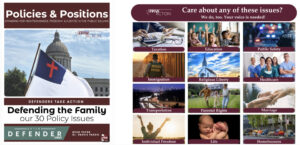
This year we again expanded our issues. We increased from 18 to 30. We were covering only 4 topics just 3 years ago so the increase in the number of topics we are now reviewing has increased dramatically. You can read about each issue in our “Policies & Positions” booklet – please click here.
III. Action Alerts
Going beyond bill summaries and issue analysis, we took practical action: We issued 452 Action Alerts for Defenders to register PRO or CON on bills.
To empower our efforts, we provided considerable updates to our Washington Defender App to influence legislation. We want to thank all who faithfully participated in influencing bills either by way of the app, or on the FPIW Action website, which had nearly 20,000 unique visitors.
IV. The Good
The Good News is that these bills passed both chambers of the Legislature:
• HB 2088 allows licensed dietitians from other states to practice in Washington without needing to obtain additional licenses, and vice versa. It is a bipartisan bill known as the Dietitian Licensure Compact.
• HB 2104 strengthens Washington’s wildfire response by making the aviation assurance program permanent and ensuring that fire departments have the financial certainty to deploy firefighting aircraft during the most critical moments of a wildfire.
 • HB 2168 allows EMS overdose data to be input into the national and state systems, improving coordination among public safety, public health, and treatment providers; prevent accidental overdoses; and target resources to the highest-risk communities.
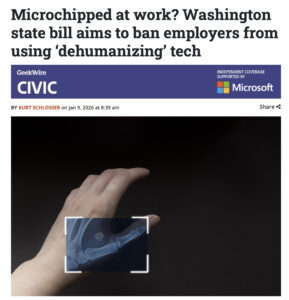
• HB 2303 protects workers’ bodily autonomy and personal privacy by prohibiting employers from requesting, requiring or coercing employees to have microchips implanted in their bodies.
• HB 2323 creates a blue envelope for drivers who are on the autism spectrum to keep in their vehicle with their license, registration, and a brief explanation of their condition and how best to communicate with them.
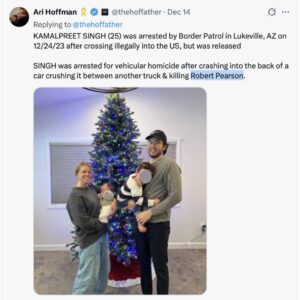
• HB 2410, developed in response to the recent rash of truck accidents across the country involving illegal immigrants, establishes a truck safety and education council to reduce serious crashes while strengthening the trucking industry in Washington.
• HB 2532 regulates the sale and distribution of nitrous oxide (laughing gas). The small canisters are currently used for getting high – not for hospital, dental or legitimate industrial applications.
 • HB 2534 clarifies that a child of a military family meets residency for school enrollment when a parent is transferred to a military installation in Washington or a bordering state or is relocating due to a military exigency under official orders.
• HB 2557 requires school districts to provide parents or legal guardians a copy of a student’s special education evaluation report at least five days before any meeting where eligibility is discussed or decided.
• HB 2594 declares that homeless children and youths must have equal access to the same free, appropriate public education provided to other children, and that homelessness alone is not a reason to separate them from the mainstream school environment.
• SB 5105 expands the crime of sexual exploitation of a minor and related offenses involving depictions of minors engaged in sexually explicit conducts. It also increases the statute of limitations for certain offenses.
There is more Good News! Many of our ‘Top’ bad bills died in the Legislature and did not become law:
• HB 1152 would have imposed sweeping new firearm storage mandates in both vehicles and residences. While framed as a ‘public safety measure’, the law would have placed the burden of criminal liability on lawful gun owners even when they had done nothing violent or malicious.
 • HB 2097 was another attempt to tax businesses. The bill introduced county B&O taxes on top of already existing state and city taxes. This proposed law did not even receive a public hearing.
• HB 2100 would have burdened any small business or corporation with more than 20 employees and over $5 million in gross receipts with a new payroll tax. This created an incentive to cap salaries, move high-paying jobs out of Washington, or reclassify employees as contractors.
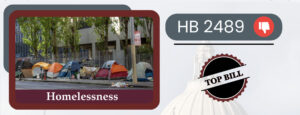
• HB 2489 declared that people engaging in “lifesustaining activities” (sleeping, resting, keeping belongings, etc.) in public spaces and could not have been cited, arrested, or removed unless specific, narrowly defined shelter options were available and offered. The bill conflicted with a view that public spaces should be safe, clean, and open to all—families, businesses, and churches—not reserved for semipermanent encampments shielded from consequence.
• HB 2641 would have prohibited all Washington state law enforcement agencies from hiring anyone who was hired as a sworn officer of ICE or CBP during the previous five years. Framed as the “ICE Out Act”, it made clear this political message: immigration enforcement officers are uniquely suspect and unfit for local policing in Washington, regardless of their record or service.
 • SB 5826 would have mandated that public higher education institutions provide access to the abortion pill for students. This same bill was introduced during the 2025 Legislative Session as SB 5321. It did not move beyond its initial public hearing and thankfully, this bill died in the Senate Ways & Means Committee.
• SB 5973 a.k.a. “The Initiative Killer”, would have required an initiative or referendum sponsor to gather at least 1,000 signatures from legal voters—and submit their names and full addresses—before the Secretary of State would even issue a ballot title.The proposed bill would have also prohibited compensating petition workers based on the number of signatures they collected.
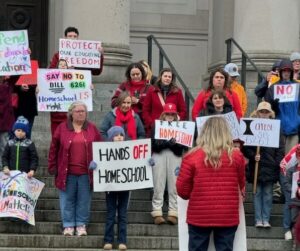 • SB 6261 would have required parents who do not enroll their child in public or private school at age six to file a signed declaration of their plan regarding the education of that child in the school years when the child turned six and seven. What’s most boggling about this proposed law is that home schools are dramatically outperforming our public schools; and yet, we have a couple Democratic bill sponsors who just can’t seem to leave home schools alone. This bill has died quickly two years running – as it should.
Other notable ‘Bad Bills’ that failed to progress through the Legislature include:
• HB 1836 was a bill that would have forced businesses to pay higher B&O taxes so politicians and bureaucrats could hand out journalism grants to favored newsrooms. This would not define a free press, it would be a subsidized press. If local news is truly serving its community, readers and advertisers—not the government—should decide whether it survives. Tax-funded news corps programs are handouts, not market solutions.
• HB 2260 required petition signers to provide full residence addresses, not just name and signature, and tightened address matching rules for signature validation. It also imposed new requirements and penalties on petition signature gatherers, including identification and address rules, expanding what could be used to challenge signatures or disqualify sheets.
 • HB 2403 would have reclassified felony “Failure to Register as a Sex Offender” as a seriousness level I, unranked class C felony and removed the provision that makes a third or later failure to register a more serious class B felony. It amended the Sentencing Reform Act so that a second or subsequent felony failure to register would have no longer counted as a “sex offense,” which would have reduced how seriously it is treated for future sentencing and registration consequences.
• SB 2614 would have explicitly authorized home cultivation and allowed people to keep the marijuana produced, meaning substantially more usable cannabis would have accumulated in residences than under the current one ounce possession limit from retail purchases. More cannabis stored and processed in homes would increase the chances that kids, teens, or vulnerable adults in those environments could experiment, be unintentionally exposed, or access edibles and concentrates that look harmless but potentially carry high THC doses.
• SB 5312, sponsored by a group of Democratic senators, aimed to reduce the legal penalties for those convicted in “Net Nanny” operations — stings where law enforcement officers pose as minors to catch online sex predators. Thankfully, this bill died for the second consecutive year.
• SB 5754 would have authorized creation and activation of the Washington State Public Bank, a cooperative style depository for state, local, and tribal government funds. It would have let the public bank borrow against public deposits and issue its own debt, layering leverage and credit risk onto taxpayer funds if loans underperformed.
V. The Bad
These are a sampling of the many, many Good Bills that sadly did not make it out of committee this year:
• HB 1122 was a bipartisan effort that required OSPI to report on effective policies for limiting student mobile phone use during instructional hours, with exceptions for emergencies, disabilities, English learners, health conditions, and instructional needs.
• HB 1307 would have eased the burden on families by removing sales and use tax on diapers and essential childcare products. This bipartisan bill died without a hearing.
 • HB 1668, a bipartisan bill sponsored by Lauren Davis, D, would have tightened accountability for offenders on community custody and improved information-sharing with the Department of Corrections (DOC).
• HB 1759 a bill designed to designate the 12th day of December the “Day of the 12’s” couldn’t make it out of the Senate Rules Committee, even after winning their second Super Bowl. Good grief. . . . Say it ain’t so.
• HB 2133 would have made property tax exemptions permanent for multipurpose senior citizen centers.
• HB 2135 would have modified and extended the adaptive retail sales and use tax preferences for disabled veterans.
• HB 2153 would have prohibited homebuyers from receiving multiple state-funded down payment assistance loans and grants. This proposed legislation couldn’t even get a public hearing. Why?
• HB 2167 would have reduced the sales tax rate in the event of an income tax on individual earnings. That sure would that have come in handy this year.
• HB 2349 is a bipartisan sponsored bill that would have provided community notification regarding the release or discharge of sexually violent predators.
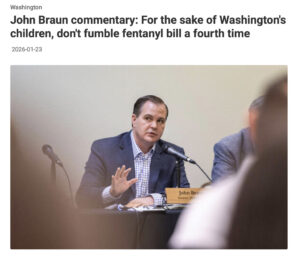 • SB 5071 updates the ‘endangerment with a controlled substance’ statute to include fentanyl or synthetic opioids. As pictured below, Senate Republican Leader John Braun (R-20th District) was the primary sponsor of that bill that unfortunately did not pass.
• SB 5729 would have encouraged more affordable housing construction by streamlining the permitting process.
• SB 5819 would have required paid protestors to pay a sales and use tax on their earnings. This bill didn’t receive a hearing.
• SB 5866 would have increased frontline staffing within the Department of Children, Youth and Families (DCYF) instead of continuing the management level bloat. It did not receive a hearing.
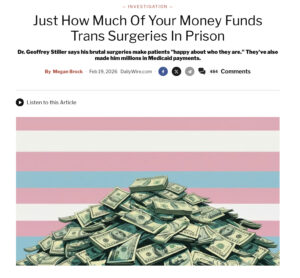
• SB 5867 would have made it possible to support mobile pregnancy units to improve maternal and infant health. I guess providing gender-assignment procedures in our prisons was more important.
• SB 6006 would have exempted food banks from the retail sales tax.
• SB 6259 This bill would have required college students to forfeit eligibility for state financial aid and to pay restitution if they damaged a public institution of higher education.
 Additional Bad News is that these terrible bills did, in fact, become law:
• HB 1390 repeals the Community Protection Program (CPP) in statute, which is a distinct track for people with developmental disabilities who had committed serious crimes or clearly dangerous sexual or violent acts and were considered likely to reoffend if not tightly supervised.
• HB 1909 opens the door to state-level consolidation that could erode local control over municipal and district courts that are currently accountable to their communities. Smaller counties and cities, which already operate under tight budgets, may ultimately face mandates or restructuring costs flowing from the task force’s recommendations. The composition of the task force, heavily weighted toward institutional stakeholders and advocacy groups, risks predetermining an outcome favoring expansion of centralized authority rather than preserving local flexibility
• HB 1916 narrows the grounds and procedures for challenging a voter’s eligibility, requires challengers to submit detailed, signed affidavits under penalty of perjury, and mandates dismissal of challenges that do not strictly comply with prescribed forms.
• HB 2251 shifts money away from specific air quality and overburdened community projects toward broader economic and political goals thereby diluting any environmental justification for the tax in the first place. If the revenue isn’t tightly tied to clear emissions reductions, the program increasingly looks like a general revenue source rather than an environmental tool. To add insult to injury, this bill removes payments to agricultural fuel purchasers as an allowable use of CCA funds. That means the bill explicitly eliminates a mechanism that was promised to cushion or offset CO2-driven cost impacts on farmers and other agricultural fuel users.
VI. The Ugly
Let’s start the Ugly News with our “Top” good bills that sadly did not make it out of committee this year:
 • HB 1228 would have modernized Washington’s impaired driving laws by clarifying and strengthening the standards for toxicology testing used in DUI-related cases.
• HB 2146 would have strengthened WA law to more clearly and forcefully combat the sexual exploitation of minors. It also would have held parents or guardians, criminally accountable if they knowingly permitted a child under their care to be exploited.
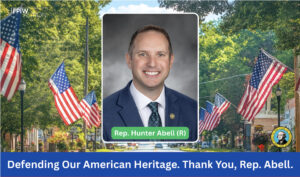
• HB 2197 would have ensured that English is the official language of the state of Washington. It would have required that official public documents, records, proceedings, and publications of the state be in English, with defined exceptions. This bill seeks to defend our American heritage.
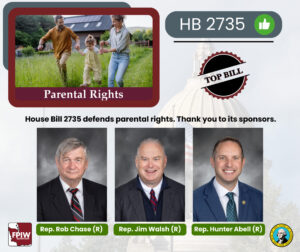 • HB 2735 would have recognized that parents who choose to bring a child into the world assume enduring fiduciary duties of care and loyalty, and affirmed that parental rights are a fundamental liberty interest consistent with the United States Supreme Court.
• SB 5097 utilized neutral language about physiological and hormonal variation and endocrine characteristics but made clear its primary purpose was to protect the female category in sports based on objective biology, not subjective identity.
• SB 5850 strengthened the integrity of our initiative and referendum system by clarifying what constitutes unlawful interference, making it illegal to intimidate, harass, or obstruct signature gatherers, and prohibiting any attempts to corrupt the process.
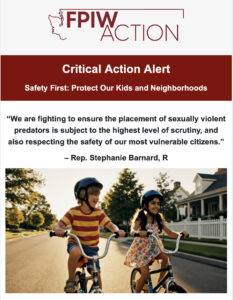
• SB 6339 would have limited where released sexually violent predators could reside. It requires the court to assess if a less restrictive alternative (LRA), such as community-based treatment or supervised release, is appropriate for the community’s safety. We issued a Critical Action Alert for this bill:
The Ugly News finishes with these “Top” bad bills, which have passed both chambers and are headed to the Governor’s desk:
• HB 2105 is yet again another “anti-ICE bill” designed to protect illegal immigrants, even though low-end estimates of illegals in Washington State remain at several hundred thousand. The bill creates a new “Immigrant Worker Protection Act” in Title 49 RCW that regulates how Washington employers respond to federal immigration-related workplace enforcement and I-9 inspections.
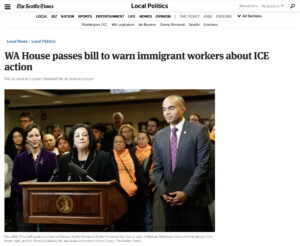
• SB 5068 devalues American citizenship by allowing non-citizens to be hired in several important government positions, including law enforcement agencies, fire departments, and prosecuting attorneys’ offices. It replaces long-standing U.S. citizenship or permanent residency requirements with a broad standard allowing anyone legally authorized to work in the United States under federal law.
• SB 5855 restricts law enforcement officers from wearing most types of face coverings while interacting with the public, except in narrowly defined situations such as undercover work or SWAT operations. Although presented as a transparency measure, the bill overlooks legitimate safety concerns for officers who may face retaliation, targeted harassment, or identification-based threats when their faces must remain fully exposed in all public interactions.
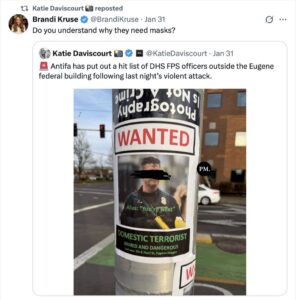 • SB 5917 will significantly expand the role of the Department of Corrections by authorizing it to acquire, distribute, and dispense abortion pills not only within its custody but to the public, a function far outside its core mission. This bill effectively turns a corrections agency into a statewide pharmaceutical distributor of abortion pills that not only murders pre-born babies but jeopardizes the life and health of women who take abortion pills.
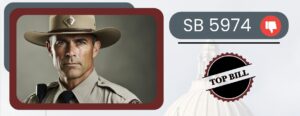
• SB 5974 lets the state and unelected boards control sheriff eligibility through mandatory background checks, psychological exams, and other screening, with CJTC publicly labeling candidates “eligible” or “ineligible,” which influences or effectively limits who voters can choose. If a sheriff loses certification under these state-defined standards, the office becomes automatically vacant, allowing removal without an election or recall and placing complete power in an unelected state board in Olympia.
• SB 6182 supports taxpayer-funded abortion here in Washington. The bill establishes an “abortion savings program” within the Department of Health to provide grants that support access to abortions for individuals in Washington who lack sufficient resources. To fund the program, it creates an annual “coverage assessment” on certain health carriers offering plans on the state health benefit exchange; that is, it is a type of “abortion mandate” against some health carriers to pay for abortions.
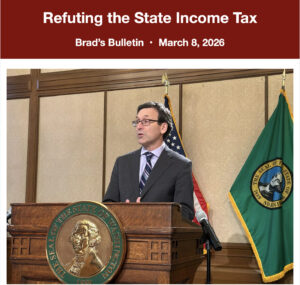
• SB 6346 is titled “Establishing a tax on millionaires” and was sponsored exclusively by Democratic legislators who have long pushed for state-level income tax. Washington voters have repeatedly rejected state income tax proposals at the ballot, signaling a clear, longstanding taxpayer mandate against this kind of tax. Now that the bill is signed and will likely be upheld in court, thresholds can be lowered over time, converting what starts as a “millionaire tax” into a tax on everyone. For three arguments against the state income tax on constitutional, moral, and democratic grounds, please click here for our Brad’s Bulletin.
VII. Valiant Opposition
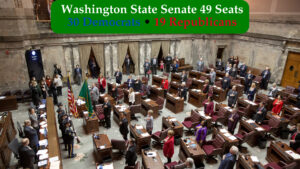
Do be encouraged that the House and Senate GOP made valiant efforts to stop another Left-wing onslaught of harmful legislation. On multiple occasions, conservative lawmakers debated into the wee hours of the morning to stand for family values. Our conservative legislators fought for over 24 straight hours against the Income Tax bill. The Republican debates were lively and on point and done with professional decorum.
As illustrated below, we need to keep in mind the balance of power in each chamber — the Republicans were certainly a minority.

VIII. Previous Brad’s Bulletins
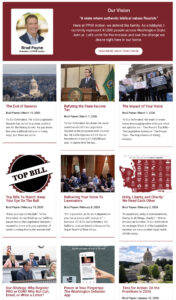
For additional insights, you have access to previous Brad’s Bulletins. The Bulletins provided weekly updates and more in-depth details as we witnessed the unfolding drama first-hand in Olympia. Click here or the image below:
IX. Four Major Themes: Life, Crime, Parents, and Taxes
As in past years, there remain four major, overarching themes that tend to be obvious each Session:

(1) Democrats do not believe that life is sacred. Democrats continue to push legislation to expand abortion. For the second consecutive year they introduced a bill to place abortion pills on every college campus in Washington State. A new bill this year will now allow the Department of Corrections to acquire, distribute and dispense abortion pills. Furthermore, Democrats do not feel it is necessary to remove young children from the homes of chronic drug abusers and seem to have no issue with children’s exposure to fentanyl and other drugs, despite an exploding number of such deaths across the state. Multiple amendments to redefine ‘imminent physical harm’ were voted down by Democrats this Session.
 (2) Democrats believe that criminals’ rights are more important than victims’ rights. They continue to go to great lengths to protect illegal immigrants here in Washington. They have passed laws to make it illegal to cooperate with the federal government and members of ICE attempting to arrest and deport illegal immigrants who have committed crimes. They also have made it easier for them to register to vote and even passed a law that will allow non-citizens to fill critical public safety positions. FPIW Action has repeatedly highlighted bills this Session that reduced accountability for criminals, and with hundreds of thousands of illegals in Washington State alone, mass illegal immigration remains a concern.
 (3) Democrats believe they are better parents. By stripping away our parental rights in both the House and Senate, Democrats have once again made it clear that they have the final say over your children’s school curriculum, their medical decisions, their mental health, and their sexual identity, all of which drives a wedge between parents and their children. Liberal lawmakers also have taken a strong stand for boys who want to participate in girls’ sports – even defying presidential executive orders and refusing to hold a hearing on Initiative IL26-638 which was written to protect girls’ sports. Thanks to the Democrats, boys can still invade girls’ locker rooms, even where alternative showers and bathroom facilities are available.
 (4) Lastly, Democrats better understand how to spend your hard-earned dollars. Democrats have introduced a record-setting number of new taxes while increasing the state’s budget to $80 billion dollars and passing the most opposed bill ever introduced in Olympia, the ‘Millionaire’s Income Tax’. Obviously, easing the financial burden on families is not a priority for the tax-and-spend party. Washington State is currently providing the following: unemployment insurance for striking workers; reparations to “black, indigenous, and people of color” totaling up to $120,000 on a house – even if they cannot provide any proof of previous discrimination; and “gender care” and gender mutilation surgeries for prisoners.
X. Thank You, Defenders
We shall never forget this Legislative Session. With the upgrades to our Defender App, as well as our daily ‘Action Alerts’, our influence across Washington state has increased substantially. We have been delighted to welcome many thousands of new people onto the Defender Team. This growth has us excited, and we are already preparing for the upcoming 2027 Legislative Session. We are currently putting the finishing touches on our brand new FPIW Bill Evaluation System which will allow us the capacity to consistently evaluate even more bills next year. Finally, a heartfelt THANK YOU to all of you who shared this strenuous two-month journey with us. We aim to be found faithful to our calling from the Lord to “be on the alert, standing firm in the faith” (1 Corinthians 16:13a).
Defending the family,
Brad Payne, President
FPIW Action