
FPIW offers a two-part series on The Rise of Islam:
Part 1 is historical and political. It chronicles Islam’s emerging power within the cultural landscape here in Washington State, as well as samples its influence across the United States.
Part 2 is more broadly philosophical. It examines some core ideas animating Islam’s theology, ethics, and Sharia Law.
We hope both parts equip the reader with an introduction to Islam.
🇺🇸 🇺🇸 🇺🇸
“Shiite radicals believe the flag of Islam will eventually fly all over the world. Some Shiite clerics have even vowed to ‘raise the flag of Islam over the White House’.”
—Gary L. Bauer
“As Europeans are discovering and as we eventually will, Islam is hungry for converts and power. . . . We have every right and every reason to insist that Muslims stay in their own countries.”
—William R. Boggs
Should Sharia Law reign in the United States of America?
Americans have good reasons to be concerned about the rise of Islam: its theology, its ethics, and specifically its Sharia Law, a set of laws considered by Muslims to be the ideal expression of divine will for regulating a society. There are some 2 billion Muslims around the world, and millions have immigrated into the United States. With thousands of mosques across the national landscape, no one can doubt the fact that Islam has taken root. Their power and presence continue to grow, especially with a high birth rate. Such facts are often described by concerned Americans as “An Islamic Invasion”.
In this Part 2 of our series on Islam, we aim to alert our friends and allies to such a presence and threat to our American Heritage, but we also aim to be fair to Islam by avoiding extremist caricatures and by showing areas of similarities and common ground with peaceful followers. Whenever possible, we will link arms with non-Christians in a pragmatic alliance to help defend and advance pro-family causes.
I. Concerns & Political Response
Charlie Kirk summarizes points of concern:
“Islam does not believe in freedom of speech. Islam does not believe in freedom of religion. And Islam does not believe in separation of mosque and state. Those three things are antithetical to the West. . . . I cannot see a single Western country that has become more Islamic and has become a better place to live that is happier or freer. . . . I think it’s suicidal to import millions of them.”
 That is, Islam violates free speech because, for example, people have been punished for speaking out against and criticizing Muhammad and Allah. Islam does not believe in freedom of religion because it seeks to overthrow non-Muslims in a society, sometimes violently, e.g., “a religion of the sword”, in order to implement Sharia Law and regulate behavior.
Such growing concerns now have sparked a political response. In the U.S. Congress since 2025, there is a “Sharia Free America Caucus” that has gained significant popularity. U.S. Congressman Michael Cloud proclaims:
“Our nation’s strength lies in upholding the Constitution as the supreme law of the land. The rise of Sharia Law is an assault on our Constitution, our freedoms, and the Christian foundations of our nation. We cannot allow this oppressive ideology to take root in America. We cannot become like Europe and stand idly by while the bastions of liberty are eroded away, community by community.”
To be clear: It is a sacred truth that every person, regardless of religion, is created Imagio Dei, created in the immortal image of God. That fact is our fundamental equality between every human being: for every person has such “a common watermark” on the soul, as the Christian philosopher Søren Kierkegaard wrote. But it is also true that not all people uphold American values. Our American Heritage and citizenship are at stake because of mass immigration; there is “a crisis of national identity,” says Harvard University scholar Samuel Huntington. Given the fact that the United States has been rooted in Christianity for hundreds of years, Christians are concerned about the rise of an Islamic culture — what Islamic people “have, do, and think” — and especially the potential reign of such values in our home of Washington State.
II. Reviewing Part I
 In Part 1 of this series on the rise of Islam, we highlighted what is called “The Red-Green Alliance” — an alliance between godless Marxists (“Red”), aka “The Left”, as well as Muslims (“Green”), both of whom unite in their common mission to overthrow Christianity in the United States. As Patrick J. Buchanan writes: “Every gain for one faith is a loss for another.” It’s a zero-sum game: someone’s values will rule. In our state, it was once Christianity, then Leftism, and today we see Islam rising.
We profiled the historical and political landscape in Washington State, including:
• 100,000 Muslims
• Its own political action arm CAIR-WA
• 79 mosques or Islamic centers in 36 cities
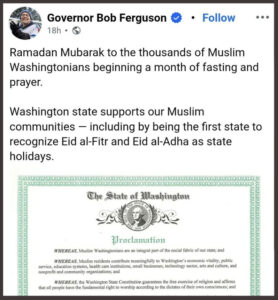
• State government recognition of two Islamic holidays — a first in the nation (see picture)
 We also sampled Islam’s presence across the United States at large:
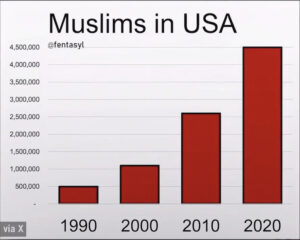
• About 5 million Muslims, and some suspect much higher, perhaps 8 million
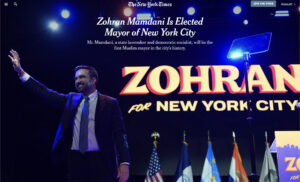
• New York City, the largest city in the US, elected a Muslim mayor.
• Nearing 3,000 mosques in the US, a significant growth from around 100 during the 1970s
• In places such as Dearborn, Michigan, one hears the Muslim call to prayer over loudspeakers many times a day.
• In Texas, there have been movements to have areas ruled by Sharia Law. (For more on a recent “rebrand”, see here.)
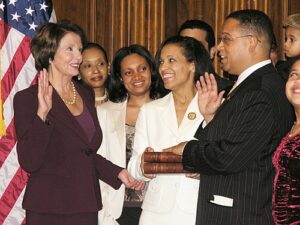
In sum, nearly 100 mosques or centers in WA, and some 3,000 in the USA. There is no sign of decline. Americans have seen the incremental rise of Islam across the nation. In 2007, for example, it was the first time the Quran was used to swear into office a new U.S. Congressman from Minnesota, Keith Ellison. (See picture below.) “Raise your right hand . . . And place your other hand upon the . . . Quran.” If a nation’s fate is its faith, switching the Bible for the Quran may be a symbolic harbinger of things to come, unless Christians take action.
III. Three Categories & Grand Strategy
 Such insights about Islam matter because the fate of our state is linked to its worldview, its faith. Here in Part 2, we offer some similarities and differences between the Christian worldview and the Islamic worldview. Prof. Peter J. Kreeft outlines the three major categories of Muslims:
(1) Terrorists
(2) Imposers of Sharia Law
(3) Practicers of Personal Piety
This Part 2 will express concerns about “Imposers of Sharia Law,” the second category, and in harmony we can outline the general, long-term strategy of Islam’s quest to impose such Sharia Law:
• In a July 4, 1998 San Ramon Valley Herald article, Lisa Gardiner wrote that CAIR co-founder Omar Ahmad proclaimed: “Islam isn’t in America to be equal to any other faith, but to become dominant. The Koran . . . should be the highest authority in America, and Islam the only accepted religion on Earth.”
• The Center for Security Policy in Washington, DC presents the first step of the Muslim Brotherhood strategy for power and dominance: “To expand the Muslim presence by birth rate, immigration, and refusal to assimilate.” We have seen this in Indonesia, which used to be Buddhist and Hindu, but is now dominated by Muslims. In our day, we are witnessing this take place across Europe as “birth rate, immigration, and refusal to assimilate” by Muslims have allowed them to gain cultural dominance.
IV. Theology: Similarities & Differences
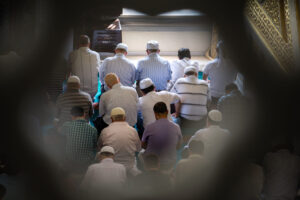
In theology, we can find similarities and differences. The holy book of Islam is the Quran, which is sometimes romanized to “Qur’an” or “Koran”. It contains 114 chapters, called suras, and then is sectioned into verses called ayat. Here are a few key points:
(1) God. First, Islam believes in one God (monotheism). In fact, it encourages people to submit their wills to God. “That’s the heart and soul of Islam itself: total surrender and submission to God, which is the formula for a saint,” writes Kreeft. (The term Islam means two things: “peace” and/or “submission to God”.) To such a general idea or abstract principle, Christians can readily agree philosophically.
But in practical terms, Islam differs as to what “God” means. Islam rejects the triune God, the Trinity, the Christian belief that God is “one being and three persons” (Father, Son, and Holy Spirit). To be clear, the concept of being differs from the concept of person. A being is something that exists. For example, a rock is a being, but not a person. A human is one being and one person. The Trinity is one being and three persons.
“Muslims see Christians as blasphemers because they believe in the Trinity,” says Jeff Meyers and David A. Noebel. The Quran 5:75–76 states: “They do blaspheme who say ‘God is one of three in a Trinity,’ for there is no god except One God. If they desist not from their word [of blasphemy], verily a grievous penalty will befall the blasphemers among them.” (For Christianity’s six fundamentals of the faith, click here.)
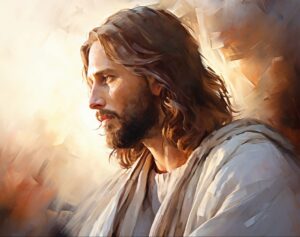 (2) Jesus. Second, Islam upholds respect and honor for Jesus as a prophet. He performed miracles, and He shall return, they say. But while Christians agree that Jesus performed miracles and believe in His Second Coming, we believe Jesus is far more than a prophet: We affirm His full divinity. Jesus is the Second Person of the Holy Trinity, consubstantial with the Father, and the one who secured our eternal salvation through His death and resurrection. Kreeft nicely summarizes the contrast between Islam and Christianity:
The Quran believes in Christ’s virgin birth, but not His resurrection; in His prophetic function (teaching) but not His priestly function (salvation) or His kingly function (ruling); in His moral authority but not His supernatural authority. To Muslims, as with Jews, Christ is the stumbling block. What’s missing is the link between the two, the “missing link,” Christ the Mediator between God and man. Mohammed and the Quran are essentially another Moses (lawgiver) and another law. What’s missing is grace, salvation, redemption. What’s missing is precisely the essential thing.
(3) Mary. Third, Islam honors Mary, the mother of Jesus. The Quran explicitly names Mary (Maryam, in Arabic), the only woman mentioned by name in the entire Quran, which shows her importance and place of reverence. Muslims rejoice at statues of Mary. On this point, too, Christians can find a similarity with the special role God gave to Mary to play in world history.
(4) Truth. Frank Chacon and Jim Burnham highlight four key ideas of Islam: “[a] Islam believes it is the true fulfillment of the religious line of prophecy that began with Abraham. [b] Christianity is the corruption of this prophetic line. [c] Islam has the sacred duty to stamp out Christianity and impose Islam throughout the world. [d] Muhammad is the last and greatest of God’s true prophets.” To this, Christians disagree because we believe that Christianity contains the fullness of divine truths.
(5) Love. Furthermore, “the Qur’an doesn’t teach that God loves us. Neither does it teach the need for a savior to atone for sin,” explains Chacon and Burnham. “If we obey God, we go to heaven. The Qur’an teaches a master-slave relationship between God and man. We are called to submit to God rather than to love Him. It rejects the idea of divine sonship and the call to love God with our whole hearts.” To this idea, Christians can reject since we are called to love God as our Heavenly Father and unite our souls with Him.
V. Ethics: Similarities & Differences
In the ethical realm, here, too, we can find similarities and differences:
(1) Moral Absolutes. First, Muslims believe in moral absolutes: the idea that some actions are absolutely, universally, objectively right or wrong for all people in all times and in all places. Kreeft points out: “You will not find many Muslims anywhere who are indifferentists, moral pragmatists, hedonists, utilitarians, materialists, subjectivists, relativists, or libertines.”
To this, Christians can agree and praise. The moral law overarches all men, and it can be known because it is “written upon our hearts” (Romans 2:15). Both Christians and Muslims, then, reject moral relativism (“My group defines the good”) and moral subjectivism (“I define the good”), two ideas promoted by Secularism that have damaged the souls of millions.
(2) Sexual Ethics & Usury. Second, there are key areas of sexual ethics and usury to which Christians and Muslims can find common ground and alliances. Islam:
• generally supports the definition of marriage as between a man and a woman, yet they have a tolerance for polygamy
• generally upholds prohibitions against homosexuality and transgenderism
• supports gender roles and modesty for women
• is generally pro-life, with some exceptions
• is strongly against usury (for a Christian view, cf. here)
Nevertheless, in terms of practical application and specific issues, Islam is often splintered. Like Protestantism has hundreds of varieties on various issues according to different interpretations of Scripture, so too are there many voices within Islam with various imams (leaders) teaching different things about the Quran and Hadith. In Islam, there is no Ultimate Judge, no Final Authority in contrast to the Catholic Church, which has the Magisterium as “the final say”, like a referee or umpire or Supreme Court.
VI. Sharia Law & Jihad
Two of the main concerns Americans have with Islam are Sharia Law and Jihad:
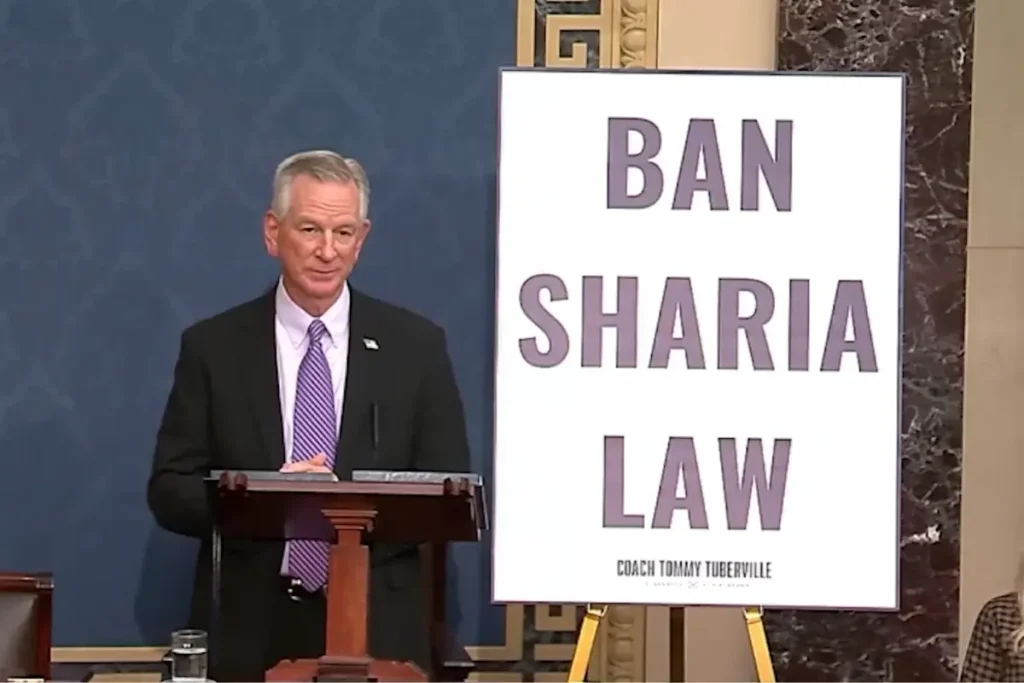
(1) Sharia Law. The term “Sharia” means “the path” or “the way,” for how Muslims are to live in accord with Islam; that is, it is the moral code on topics such as diet, hygiene, prayer, contracts, business, crime, and punishment. Muslims believe those people who are living against Islam are in rebellion. U.S. Senator Tommy Tuberville states his critique:
Sharia Law is fundamentally anti-American and has no place in our country. If you want to peacefully practice your religion, you have every right to do so under the Constitution. But if you want to come to the United States and advocate for the practice of Sharia Law over U.S. law, you should not be here. We do not want people who chant ‘Death to America’ residing in our communities and endangering our families. We must protect American values, not apologize for them.
Here are more reasons to be concerned:
According to the Pew Research Center, 88% of Muslims in Egypt, 62% in Pakistan, 86% in Jordan, and 51% in Nigeria believe that any Muslim who chooses to leave Islam should be put to death. Similar, if not identical, numbers are in favor of stoning people who commit adultery, severely punishing those who criticize Muhammad or Islam, and chopping off hands for theft. All of these practices are a part of the penal code of Islamic law, which is known as Sharia.
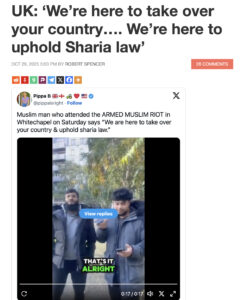 Fundamentally, there seems to be a lack of clarity in Islam regarding Sharia Law, which causes confusion, fear, and misunderstandings. “Different schools of thought, known as madhabs, have developed varying interpretations of Sharia,” says Our History. As Ashraf Ali writes with a similar point: “Sharia claims divine origin, making its core moral principles immutable. However, the application of Sharia . . . relies on human interpretation and can evolve via scholarly consensus and contextual reasoning.”
Yet others assert more specific concerns in Islam:
• Theft is punishable by amputation of the hands (Quran 5:38).
• Criticizing or denying Allah is punishable by death.
• A Muslim who becomes a non-Muslim is punishable by death.
• A non-Muslim who leads a Muslim away from Islam is punishable by death.
• A non-Muslim man who marries a Muslim woman is punishable by death.
• Testimonies of four male witnesses are required to prove rape of a female (Quran 24:13).
• A woman or girl found guilty of adultery is punishable by death.
• A woman can have one husband, who can have up to four wives.
• A man can beat his wife for insubordination (Quran 4:34).
• A man can unilaterally divorce his wife; a wife needs her husband’s consent to divorce.
• A woman cannot speak alone to a man who is not her husband or relative.
• Muslims can lie to non-Muslims to advance Islam.
(For more specifics, see the essay “Islam Is Inconsistent with the U.S. Constitution” from the RAIR Foundation. Also, World Religion News offers more examples and insights in its essay “Why the Sharia Law Is So Dangerous for Our World”.)
Defenders of Sharia Law, such as Hafiz M. Ahmed, say that the punishments, such as stoning and amputation, are rarely enforced, and that much of the above no longer applies to today’s culture. However, others disagree. Recently, for instance, there was a disturbing video post on social media that apparently shows Islamic support for child-rape, according to a Muslim cleric in the United States:
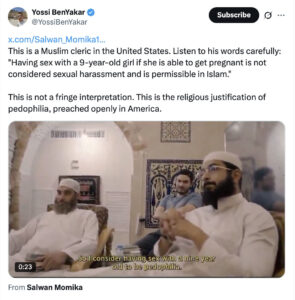
A fundamental point is this: The burden is upon Islam itself and its leaders to clean up its directives and define what exactly “Sharia Law” means. Until then, Christians and others have good reasons to be cautious toward the consequences and imposition.
(2) Jihad. There is no debate that the term “jihad” can refer to an internal struggle within a person. Yet Robert Spencer, who leads Jihad Watch, claims that “the primary meaning of the word ‘jihad’ in the Qur’an is unmistakably warfare” for some Muslims. Looking at history, the Harvard scholar Samuel Huntington documents: “Islam has bloody borders.” And: “Islam’s borders are bloody and so are its innards. The fundamental problem for the West is not Islamic fundamentalism. It is Islam [itself], a different civilization whose people are convinced of the superiority of their culture.”
No doubt there has been violence between various Muslims themselves, but there has been violence against others, too. Going back to the days of Mohammad, there have been aggressive attacks on non-Muslim neighbors, especially Christians. Some 80 years ago, in 1936, the great Christian writer from England, Hilaire Belloc, saw the rise of Islam coming again against Christians and described it as our “most formidable and persistent enemy”.
VII. Islam’s Will to Win
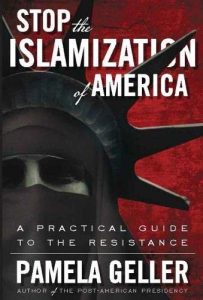 Islam is winning in Washington State because it has a strong will to win: it has passion, not indifference; it has a high birth rate, not mass abortion, not contraception; it has clear commands from Allah like cold-hard spikes, says Kreeft, and not the warm, fuzzy, gray “guidelines” found in other worldviews such as New Ageism. As Abdu Murray points out:
Islam offers what Secularism can’t: a clear message and a sense of belonging. For young men especially, Islam presents masculinity as virtuous, not toxic. It calls them to discipline, duty, and identity. In a culture that sneers at male strength and a mainline church that too often avoids moral rigor, Islam’s conviction can look like courage.
Above all, Islam is rising because it rejects the secular completely. In the Los Angeles Times, scholar Mahmood Ahad Ghazi said:
Islam is the most dynamic force today because, unlike other major religions, it hasn’t succumbed to secularism. It doesn’t divide human life between the religious and the secular, the spiritual and the totality of human existence.
VIII. Christianity’s Will to Win
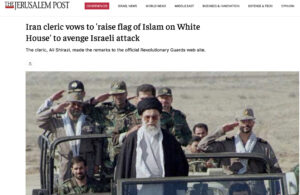 In our day, we are witnessing the dismantling of what we hold dear as Americans, and the rise of Islam is part of that. Will the United States of America continue its Christian-rooted national motto of “One Nation Under God”, or will it transform into an Islamic version of “One Nation Under Allah”? Will the flag of Islam fly over the White House? (See picture.) In our neighborhoods, will we hear the call to Islamic prayer many times each day, too?
As Christians, our enemies are indifference, apostasy of the faith, and an alarmingly low birth rate — and upon those three things rests much of our nation’s fate. Yet there is hope.
• George Barna reports: “For the first time in decades, younger adults—Gen Z and Millennials—are now the most regular churchgoers, outpacing older generations, who once formed the backbone of church attendance.”
• In sync, Gallup reveals: “42% of men aged 18-29 now say religion is ‘very important’ in their lives — a sharp jump from just 28% in 2022–2023.”
So there are positive signs of hope for a reemergence of Christianity.
Defending American Identity is a great battle of our era, perhaps the fight of our lifetimes, as we live through a turning point in American history: removing illegal aliens; assimilating immigrants; stopping “Celebrate Diversity” agendas, including religious diversity; and re-Christianizing the culture. At FPIW, we know our patriotic friends and allies wish to be found faithful to protecting our country.
As part of the battle, it is worth fighting against the imposition of Sharia Law. “After 1400 years of struggle, Muslims are poised to transform Europe into a Muslim stronghold,” explains Chacon and Burnham. “Then, they will try to accomplish the same thing in the Americas” — and they already have to some extent. Islam has taken root and is spreading. It has entered into our government, our laws, our political landscape. Let us not make the same errors as Europe, but rise to the challenge we are witnessing before our very eyes. We encourage not hysteria, but urgency and the equipping of our friends with accurate knowledge. Now is our time to expose such a threat, vote against pro-Islam legislation and legislators, and spread the Good News that “Christ is King”.
✝️ ✝️ ✝️